
Dallas County Most Wanted List
Start with the Dallas County Wanted Search, the county's official hub for this service. Dallas County bills it as a 24-hour online tool covering traffic, criminal, and civil fines and fees. Expect labels like warrant, scofflaw, delinquent offender, and approximate balance. The companion Top 50/offenders list is a curated display, not a roster of every arrest or everyone in the jail.
The county updates the service routinely but stops short of calling it current for every legal purpose. Entries carry a photo column, though not every entry will show a photo. Treat a listing as an administrative signal about a person's status.
For a person-specific question, the official warrant-search form is the better tool. It works differently from the Top 50 list. Neither page replaces confirmation from DCSO or the issuing court.
Dallas Wanted Listing Fields
The sheriff's fields can be easy to misread. A single result may pull together a name, an identifier, warrant details, a balance, and a public-list status. That is not a court history. It tells you nothing about what later happened in a case. The table below matches the columns described for the county's Top 50 style list.
| Field | How to read it |
|---|---|
| Name, address, DOB, race, and sex | Identifying information that should be checked against more than one source when names are common. |
| Outstanding balance | An amount associated with the county's wanted or delinquent-offender service, not a description of a sentence. |
| Warrant | A warrant-related status that requires confirmation with DCSO or the issuing court. |
| Scofflaw | A county service category used in the wanted and delinquent-offender context. |
| Photo column | A possible agency-displayed image on the sheriff's own list, not a photo published or copied here. |
Dallas County attaches its own public warning, and it deserves attention. A result can shift after a payment, a court action, or an agency review of its records. So use what you find to identify the right official contact. Do not treat a search page as the final word on anyone's legal standing.
Use Dallas County Wanted Search
Why two separate systems? The county keeps its wanted pages apart from Jail Lookup because they answer different questions. Jail Lookup tracks who is in county custody right now. The wanted service covers warrants, delinquent offenders, and scofflaw matters. Search quietly and carefully. A screen result is never a reason to confront someone.
- Open the official county wanted-search home and read its warning before relying on any result.
- Use the search interface with a known name, ZIP code, case number, citation number, license plate, VIN, or the documented demographic filters.
- Compare the result with the person or case identifiers available to you. Do not rely on a name by itself.
- For a direct question about a possible county warrant, call the published DCSO warrant-information line or the issuing court.
- If the concern is a safety tip, send it to the official tip channel. Do not approach or try to detain the person.
Someone on the wanted list who is later arrested may show up in the separate Dallas County booking and roster path. Keep the two findings distinct. A later booking does not prove that every detail you saw on the wanted list was accurate when you viewed it.
Dallas County Warrant Check
The county's warrant-search form is unusually flexible. You can search by name and ZIP, case number, citation number, or license plate and VIN. There are also filters for warrants, photos, and scofflaw-blocked status. Results can surface balances and warrant data, but the county warns against treating the service as the final word for every legal purpose. Direct confirmation remains the necessary step.
| Warrant-related term | Practical next step |
|---|---|
| Possible active county warrant | Confirm with DCSO Warrant Information at (214) 761-9026 or the issuing court. |
| Case or citation result | Use the number to reach the responsible court or clerk for current status. |
| Scofflaw or delinquent-offender entry | Read the county category and balance information, then seek confirmation from the official office. |
| Question about one's own status | Contact the court or an attorney to resolve it safely and lawfully. |
No shortcut around a warrant is a safe one. Nothing here advises dodging service or enforcement. A court, an attorney, or the responsible county office can lay out the proper route for your situation. The Texas DPS Most Wanted program is a separate statewide effort, and appearing there says nothing about Dallas County's service.
Note: The county's filters can help locate a possible record, but the agency or court controlling the case still needs to confirm any displayed result.
Dallas Warrant and Scofflaw System
This local service bundles several kinds of status into one interface. It is far more than a fugitive-mugshot page. Delinquent offenders, scofflaw status, balances, case and citation searches, plate or VIN fields, demographics, and the Top 50 presentation all live here. That mix is exactly why you should read the county's own labels rather than assume every entry means the same type of warrant.
Photos, where the official list shows them, stay with the sheriff's webpage. The screenshot here only illustrates the county's list and is not for identification or sharing. The Dallas County Top 50 list shows how the county arranges its columns.
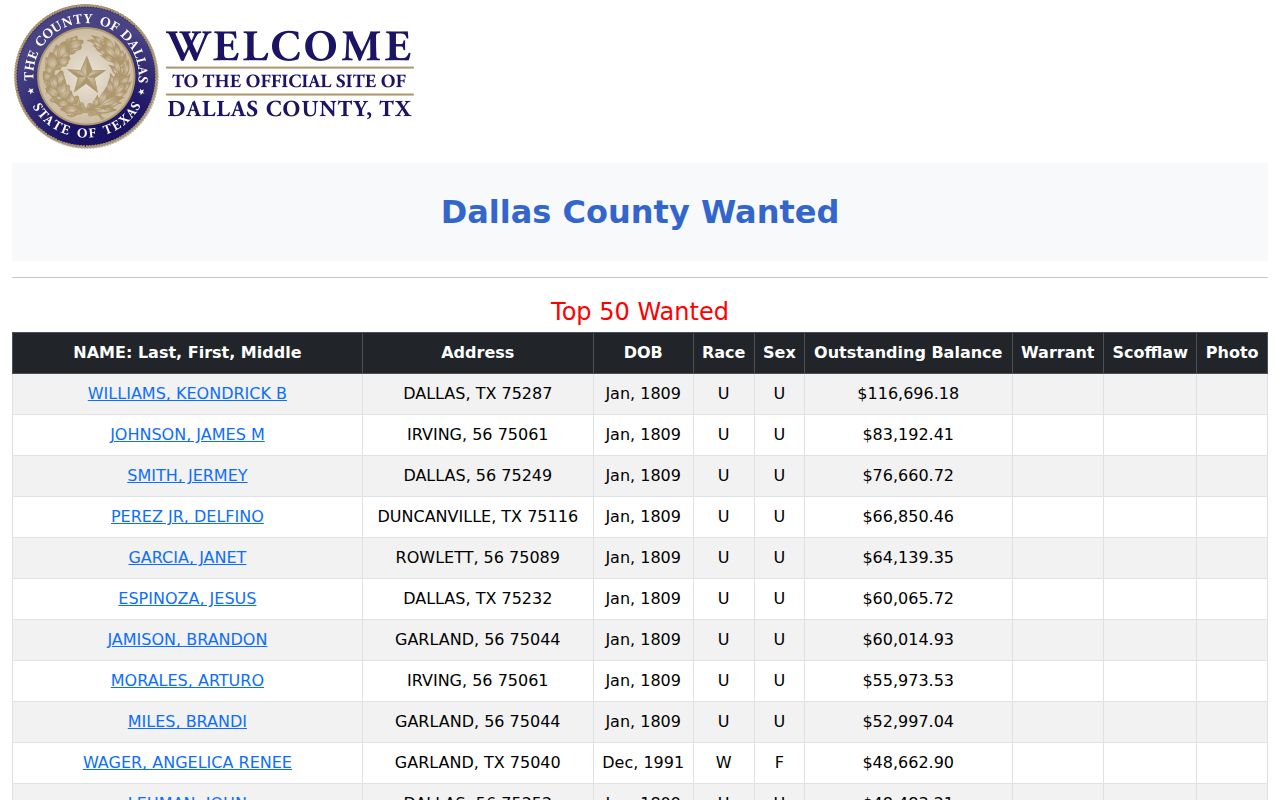
The capture documents the official interface. It also makes a simpler point: rely on the county's current page, not a copied image or a third-party listing.
Dallas County Safety and Tips
Dallas County tells the public plainly: do not rely on the wanted service alone. Never attempt an apprehension yourself, either. Have information that might help? The sheriff's FAQ routes crime tips to DCSO at (214) 653-3530 and to Crime Stoppers. Dallas County CSCD separately lists Dallas Area Crime Stoppers at (214) 965-9000. Each number serves a different purpose. Check the county's page before you dial.
Safety notice: Never approach, follow, contact, or attempt to detain someone on a wanted list. Call law enforcement with a tip instead.
The Texas DPS runs its own statewide program, and it lists 1-800-252-TIPS for anonymous Crime Stoppers tips. Rewards may appear on those state profiles. Keep it separate from the Dallas County list, though. A county entry does not qualify for a state reward, and a state profile does not confirm a county listing.
Dallas County Wanted Updates
The sheriff's office keeps a Google Play listing for a Dallas County communications app, plus Facebook and X accounts that share selected public information. None of these channels is a verified replacement for the live wanted-search interface. Skip the reposted images and stale social posts. A person can come off a list after paying a fine or through another official update, which makes old screenshots unreliable.
The county's own wording keeps public awareness apart from enforcement. One entry might flag an administrative debt, a citation issue, scofflaw status, or a warrant matter. The photo and warrant filters on the search form simply narrow results; they say nothing about how serious a case is. Need a correction? Contact the office that controls the record. Have a safety concern? Use DCSO or Crime Stoppers. Keeping those roles straight protects both record accuracy and public safety.